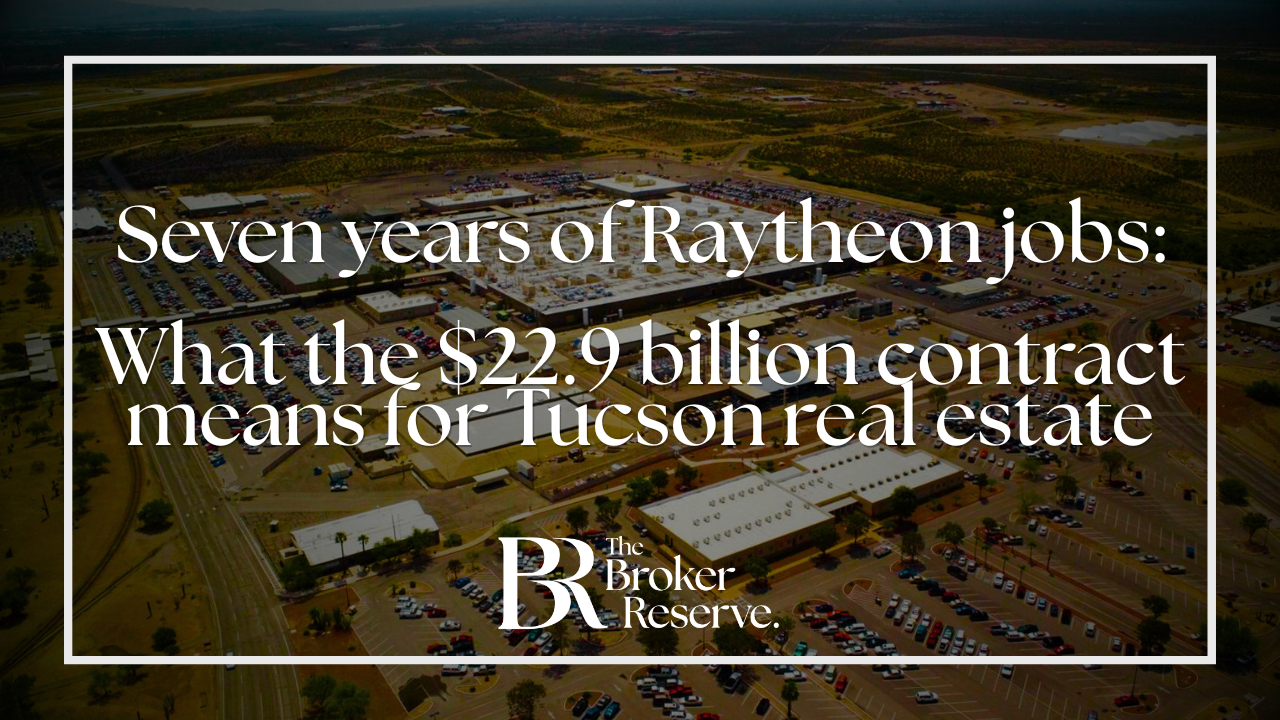
Everybody wrote the missile story last month. Raytheon, $22.9 billion, Tomahawks, seven years. I read probably fifteen versions of it and not one of them asked the question I actually care about, which is where are all these people going to live. So let me take a swing at it. Every number in here is linked so you can go check it yourself.
What actually happened
On August 17 the Navy gave Raytheon a seven year, $22.9 billion contract to build Tomahawk cruise missiles, and the plan is to get production over 1,000 a year. The Tucson plant is doing about 60 a year right now. Some of the work gets split with plants in Alabama and Massachusetts, but the Phoenix Business Journal called it the biggest single deal in the Tucson facility's history, and they were already ramping before the ink dried - they shipped three times as many Tomahawks in the first half of 2026 as they did the year before.
Here's the thing most people skipped over. It's a seven year contract. Not a one year order, not "we'll see how it goes." The Navy said flat out the whole reason they structured it this way was so Raytheon and its suppliers could actually expand capacity and add headcount without worrying the money disappears next budget cycle. When a company knows it has seven years of work paid for, it hires people and it builds buildings. That's the real estate story.
This isn't a one-off either
Look at the last fourteen months. Four big awards, all with Tucson work in them:
- June 2025 - a $1.1 billion AIM-9X contract, which took that program from about 1,400 missiles a year to 2,500.
- June 2026 - another $1.1 billion on AIM-9X. RTX said most of that work is in Tucson and that they're "significantly expanding" the engineering workforce here. Their words.
- August 10, 2026 - a $745 million SM-3 interceptor contract running through early 2031, built in Tucson and Huntsville. They said they're actively hiring for it.
- August 17, 2026 - the $22.9 billion Tomahawk deal.
Raytheon and RTX already have over 12,500 employees in Arizona. They're one of the biggest employers in the state and every one of those contracts adds to it. Now, they haven't put out a hiring number for the Tomahawk deal, so I'm not going to make one up like some people are doing. You don't need a number to see which direction this goes.
So where do these people live
The plant is on the south side by the airport and I-19. So if you're an engineer or a tech getting hired there, you're looking south and southeast. Sahuarita, Green Valley, Vail, Corona de Tucson, the ranch country out west of the freeway. Basically the affordable side of town, which is not an accident. JVM Lending's 2026 forecast calls Vail and Sahuarita some of the most affordable options in the region and says that's exactly where the first-time buyers and the investors are going. They also point out Pima County's zoning changes now allow more density near the job centers, which is another thing to watch.
Okay, so what does it do to prices
I'll give you the straight version. Tucson proper is flat. Redfin has the city at a $325K median over the three months ending July, down a hair from last year, and homes are sitting about 64 days. That's a balanced market, maybe leaning toward buyers, and one contract doesn't flip a metro of a million people overnight. Anybody telling you otherwise is selling something.
The south side is a different market though, and it was already moving before this. Long Realty's first quarter report has Sahuarita at a $339K median, up 6.9% year over year, closed sales up 16.4%, new pendings up 29%, and inventory down 21%. Vail was up 3.7% on price with closed sales up almost 10%. Read those numbers again. Sales up, pendings way up, inventory down. That's a submarket that's selling faster than it's getting new listings, and that was Q1, months before the Tomahawk contract even existed.
So the way I look at it, the south side doesn't need Raytheon to hire thousands of people tomorrow for this to matter. It needs Raytheon to keep hiring engineers and technicians every quarter for seven years in a corridor that's already short on inventory. That's exactly what a multiyear contract does. It's not a spike, it's a steady push on a market that already doesn't have enough houses, and that's how values actually move over a few years.
What I'm watching
- Land near the corridor. Acreage within 20 minutes of the airport that already has power and a real road to it is the scarce thing right now. That's what runs out first.
- Sahuarita and Vail building permits. If the builders can't keep up, resale keeps climbing. If they can, the pressure shifts to land, wells and infrastructure, which is where the money gets made anyway.
- Raytheon's own announcements. RTX said they're investing in facilities, workforce, tech and supply chain to hit the ramp. Suppliers follow the prime. Suppliers lease industrial space and their people buy houses too.
If you own something on the south side or you're looking at something, land or a house, send it over and I'll run the numbers with you. No pitch, I'll just tell you what I see.
Hudson Robison
Designated Broker, The Broker Reserve · 480.313.3234 · hudson@thebrokerreserve.com
Sources
- RTX, Aug. 17, 2026: Raytheon awarded seven-year contract for Tomahawk cruise missiles
- Arizona Daily Star: Raytheon lands $22.9B contract to boost Tomahawk production
- Real Estate Daily News: Raytheon lands record $22.9 billion Navy contract
- Phoenix Business Journal via KTAR: Raytheon lands $22.9B Tomahawk missile contract
- RTX, Aug. 10, 2026: $745 million contract for SM-3 IIA interceptors
- RTX, June 4, 2025: $1.1 billion contract to produce AIM-9X Block II missiles
- RTX, June 26, 2026: $1.1 billion contract to produce AIM-9X Block II missiles
- University of Arizona College of Engineering: Raytheon secures $1.1B contract to increase production and jobs
- Redfin: Tucson housing market, three months ending July 2026
- Long Realty: Tucson Metro and Southern Arizona Residential Market, Q1 2026
- JVM Lending: Tucson real estate market forecast for 2026
Pulled from the public sources linked above, believed reliable but not guaranteed. The Broker Reserve has no affiliation with Raytheon or RTX, nothing here is a statement by either company, and nothing here is a promise about hiring, employment or where property values go. Equal Housing Opportunity.